

The Westfield Disaster
The Sunday it Rained Fire

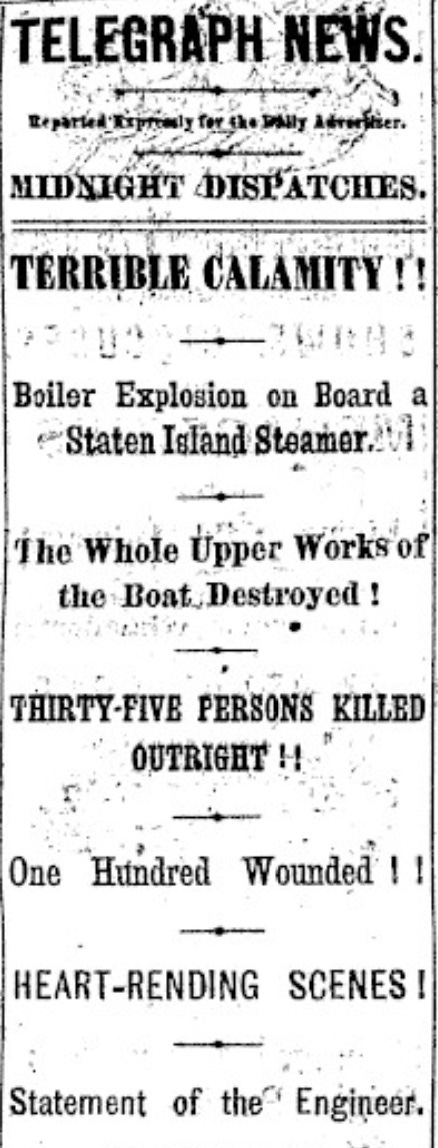
“ I was standing on the main deck leaning against the rail reading a newspaper Mr Eckel and Mr Sherlock was standing beside me Mr Phillipson and Mr Levi was sitting in the cabin. Suddenly there was a terrific explosion the violence of which helped me into the air and I fell into the hole among a confused mass of dead and dying men, women and children. I was nearly covered with the debris and almost blinded by dirt. Recovering in a moment I groped my way through the darkness and clambered out without assistance. It seemed as though everything I took hold of was red hot. My hands were dreadfully burned. A jet of steam struck me on the forehead and some falling pieces of wood or iron bruised my ankles as I was groping my way out. The scene was frightful and the groans of the wounded appalling. With the explosion in the air seemed rent with shrieks. I made my way through the debris and as a cloud of dust cleared away I gained the deck and was assisted onto the landing. There was no premonition, no sound of escaping steam with all gaily chatting or looking about. The explosion took place with a heavy rumbling sound like the blasting of rocks. I saw people hurled hither and thither and with me all was darkness for a moment. I hope never to behold another such fearful scene.”
Mayor Carroll of Syracuse
A Sunday crossing turns to slaughter
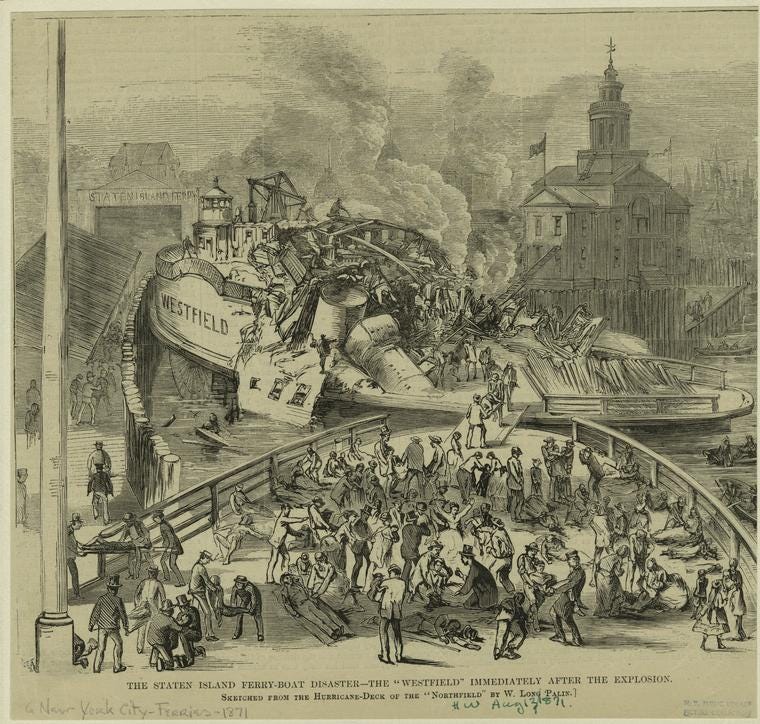
On the afternoon of July 30, 1871, the Westfield sat at the Whitehall Street dock in Manhattan, ready to carry a Sunday crowd across New York Harbour to Staten Island. It was the kind of scene the city knew well. Families heading out for a day, working people escaping the heat, and excursionists looking for relief from the furnace of a New York summer. Around 400 passengers were aboard or in the process of boarding when the ferry’s boiler burst with a force that shattered the boat from within.
The explosion came without warning. There was, by at least one account, no hissing escape of steam beforehand, no dramatic signal, no time to leap clear. One moment the boat was full of holiday traffic; the next, it was a mess of splintered timbers, torn iron, scalding water, and bodies thrown everywhere. Contemporary reporting described the blast as lifting the forward part of the vessel into the air and ripping open the whole front of the boat.
Human Agony
The explosion didn’t just break the boat; it broke families in ways that statistics can’t capture.. Bernard Smith survived, but he found himself in a waking nightmare: his wife and daughter were gone, and his nine-month-old son, Thomas, was so badly scalded he would not survive the night at the hospital..
A baby, Thomas Smith, only 9 months old, later died of injuries received in the blast. Jane Ullman of Brooklyn, aged 18, was among the dead, as was Matilda Nelson of Brooklyn, aged six. Sarah Clark and Johanna Bennett, two young girls from Jersey City, were among those initially reported missing. Deputy Sheriff John Madden, was carried from the scene but later died. A relief fund was swiftly setup and amongst those claiming funds soon afterward was John O’Connor, a badly scalded longshoreman with a wife, mother, and infant child depending on him, and John Brown, a truck man confined to his house.
Like a battlefield
Because the Westfield exploded while still docked, passersby, harbour police, firemen, ambulance surgeons, and men in nearby boats rushed toward the wreck. The dockside became a makeshift emergency ward. Carriages, express wagons, patrol wagons, and ambulances carried the injured to Center Street Hospital, Bellevue, and other places of relief. Witnesses described rescuers pouring oil over children whose skin had been swept away by the heat, their small faces frozen in shock.
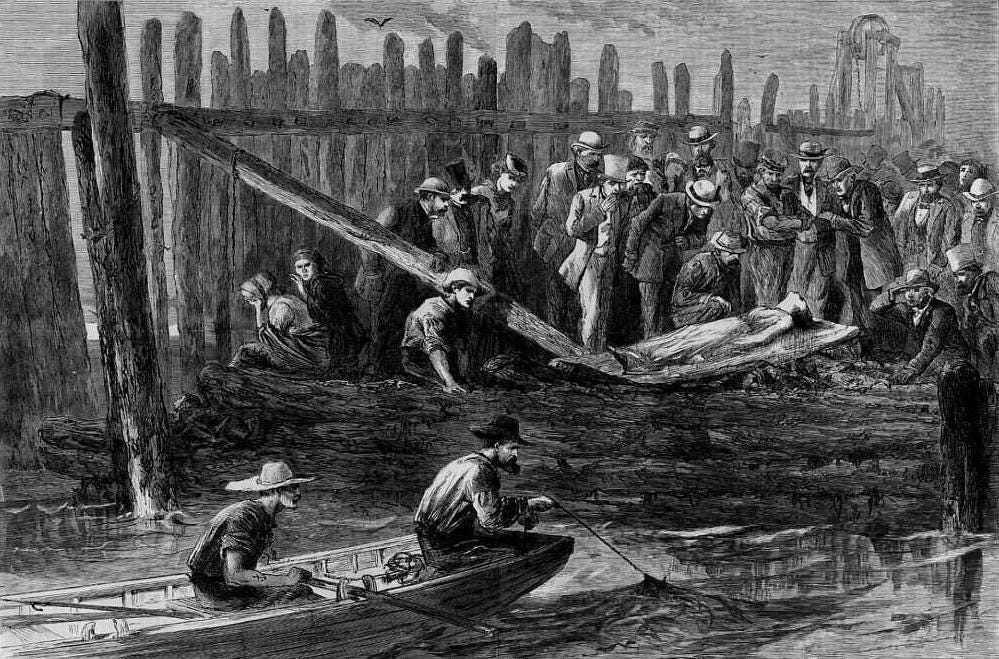
The hospitals were overwhelmed. One newspaper account says that by four o’clock more than seventy wounded had already been received at Center Street Hospital. Another says the morgue was opened at sunrise the next day, and that crowds passed through all day searching the marble slabs for familiar faces.
What made it all more dreadful was the speed with which the ordinary world still pressed in around the wreck. Clothing belonging to the missing was gathered at the precinct station and the ferry house—hats, cap baskets, travelling bags, shoes, scraps of fabric. Those objects, banal in themselves, were all that remained for many families to make identifications.
Public Spectacle.
The newspaper descriptions are brutally vivid. Steam could power a city, but when a boiler failed, it did not merely break machinery. It turned heat, pressure, metal, and water into a weapon. The Westfield’s victims were not only killed by the initial blast, but after from scalding, shock, drowning, or unsurvivable injuries.
The crowd at the Battery only deepened the emotional pressure. More than 15,000 people gathered there within an hour, and many who came to look were themselves overcome. One report says as many as fifty women fainted while viewing the dead at the morgue. The disaster had become a public spectacle, but most could not stomach it for long.
Why?
The inquiry that followed pointed toward negligence. The boiler was old, reportedly about fourteen years old, and had a patch on the cylinder. It had been inspected on June 15 and pronounced safe, but later examination suggested that the boiler failed under over-pressure rather than low water, undermining any easy attempt to blame the disaster on simple operator error.
Henry Robinson, an experienced engineer, gave a detailed statement in which he said the boiler carried 27 pounds of steam and that he could not say what caused the explosion. The superintendent, Captain Braisted, and the company president, Jacob Vanderbilt, became the focus of anger as investigators and the public looked for someone to blame.
The race and class attitudes of the time are impossible to ignore. Robinson was identified in the reporting as a coloured man, and the fury directed at him was severe, even as others argued that the true blame lay with the company and the state of the vessel itself. In a disaster like this, the blame often settles first on the person closest to the machinery, not the person most responsible for its condition.
Negligence
The outrage that followed was immediate and loud. The disaster dominated conversation across New York and beyond, with papers describing the explosion in appalling detail and demanding that such deaths should not be allowed to happen in a modern city. United States commissioners announced a thorough investigation. Coroners returned findings of criminal negligence. By mid-August, Vanderbilt, Braisted, and Robinson were committed to the Tombs after the coroner refused bail.
For a moment, it looked as though the Westfield disaster might become a case study in accountability. The names of the accused appeared in the papers alongside the dead. That in itself was unusual enough to feel like a turning point. Yet the legal culture of the age was not built to punish corporate negligence with much force, and the direction of blame was soon diluted.
When the dust settled, there was no punishment that seemed equal to the loss. The indictments came, the public shouted, the newspapers filled column after column with the names of the dead and wounded—but in the end, no one paid a truly lasting penalty for the disaster itself. (This failure to make the dead matter enough to change the world around them continues today in different ways, of course).
The company did suffer. Civil lawsuits followed, finances were strained, and the ferry’s reputation never recovered.
A Lingering Shadow
The Westfield name became a curse. For nearly 50 years, New Yorkers looked at the vessel—which was eventually repaired and put back into service—with a shudder. Even when she was finally scrapped in 1916, it was front-page news; the city had a long memory for the boat that turned a summer Sunday into a slaughter.
Today, the disaster serves as a reminder of the human cost of progress. It was ‘just’ a mechanical failure but it still left a father like Bernard Smith, standing on a dock with empty arms, wondering how a simple ferry ride could cost him the world.